
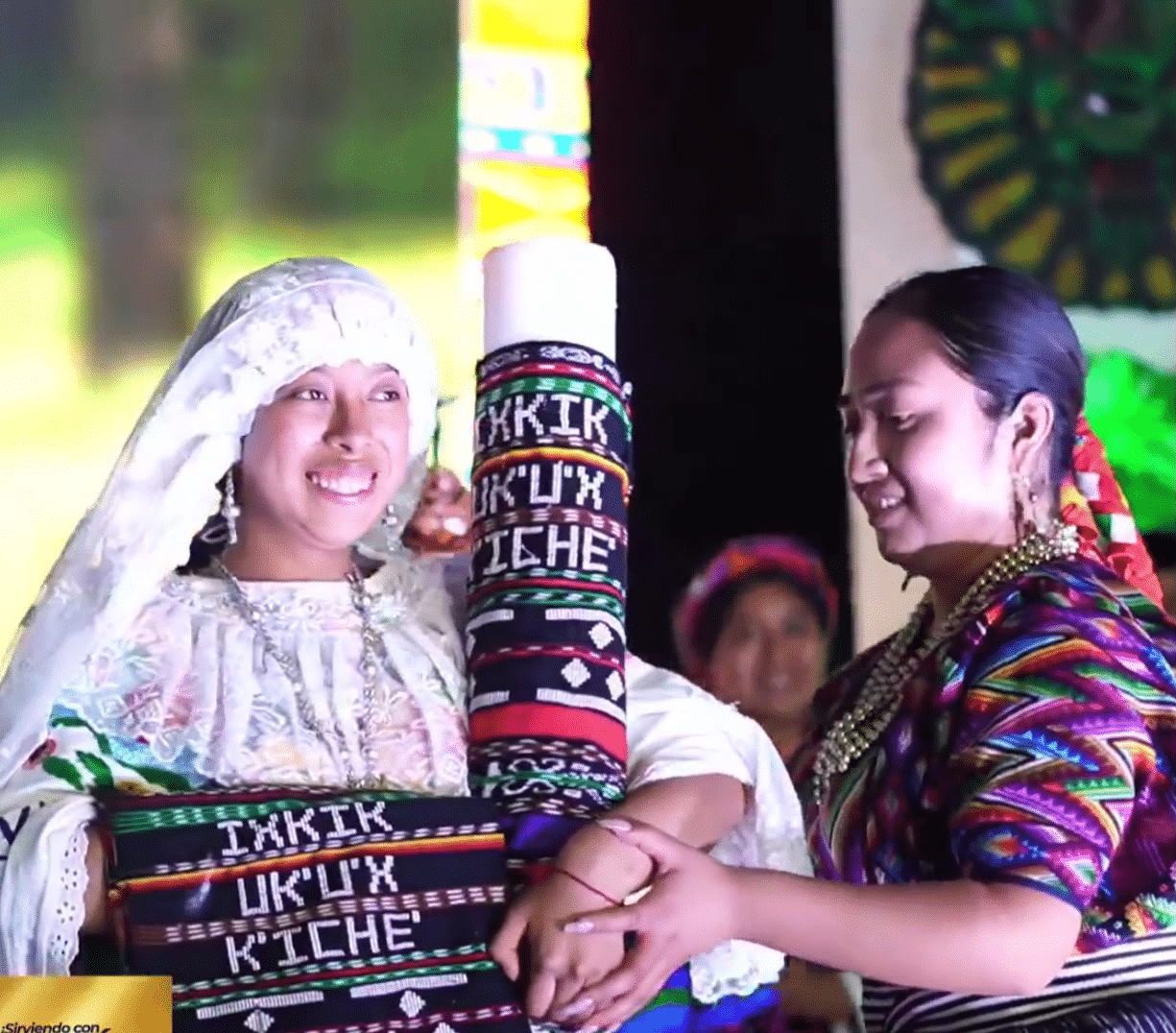
Today, September 5th, 2026 marks the first-ever International Day of the World’s Indigenous Women and Girls, a day recognizing Indigenous women as leaders, knowledge keepers, and agents of change across the globe. To celebrate this historic day, we are highlighting one of the young Indigenous leaders at Colegio Horizontes: Karelyn, a high school senior and Chajul’s current Me’al Tenam (“Daughter of the Community”). Elected earlier this year, as the current “daughter of her community,” Karelyn had the opportunity to represent Chajul at two of Guatemala’s most important and visible platforms for Indigenous representation: Rabin Ajaw and Ixkik Uk’u’x.
Guatemala’s annual Rabin Ajaw (“Daughter of the King”) festival gathered 142 Indigenous women, each representing a different municipality from across the country, to share their knowledge of their community’s specific Indigenous culture, language, and history. These women competed for the honor to serve as the national ambassador for Indigenous women and culture of Guatemala for the next year. Karelyn was named second runner-up, placing third overall, and was the only representative from the state of Quiché (where Chajul is located) to advance to both the semifinal and final rounds.
Just days later, Karelyn was selected from among 15 contestants and crowned Ixkik Uk’u’x. This title honors a young Indigenous woman chosen to serve as a cultural ambassador for Quiché, a department of Guatemala with more than one million residents and dozens of Indigenous communities, including Chajul. Over the coming year, Karelyn will act as the representative and spokesperson for Indigenous women across the state.
In the following Q&A, Karelyn reflects on what these two recent experiences meant to her, how Colegio Horizontes has helped shape her sense of identity, and her hopes for the next generation of Indigenous Maya Ixil girls.
Q: Your speeches for Rabin Ajaw and Ixkik Uk’u’x were an important part of your participation at each of these events. How did you choose your speech topics, and why were they important to you?
A: The topics of my speeches came from what I carry within me as a Maya Ixil woman and from my desire to leave a lasting legacy and make a difference. I did not want to speak merely to fulfill a participation requirement, but rather to use every word to represent our history, our culture, our women, and the dreams of our youth.
I wanted to show that Chajul and the Ixil region are home to talent, ability, and great dreams. To me, speaking also means opening doors and reminding other girls and young women that our identity does not limit us; our roots give us strength. That is why I chose themes of pride, dignity, hope, and commitment to my people. I want my voice to inspire others and to show that we can go far without compromising our identity.
Q: What did you enjoy most about your participation in both the national and state-wide cultural festivals?
A: At Rabin Ajaw, I enjoyed meeting and sharing experiences with women from different Indigenous communities across Guatemala. Each woman brought her own story, culture, and way of expressing pride in her roots. I came to understand that although our cultures are different, we are united by the desire to keep our identities alive.
At Ixkik Uk’u’x, I especially enjoyed representing Chajul and feeling that an entire town stood behind me. What I hold closest to my heart is knowing I could carry the name of Chajul with pride.
Q: What did you learn about yourself from these experiences?
A: I learned that I am much more capable than I ever imagined, and that I can speak in front of many people and confidently defend what I believe in. I also learned that representing a community requires preparation, discipline, and humility. These experiences taught me to trust my voice and helped me really comprehend that my story and culture have value.
I also realized that I wanted my participation to inspire other young girls from Chajul to think, “If she could do that, so can I.”
Q: Did your participation in these events change how you perceive or value your identity as a Maya Ixil woman? If so, how?
A: Yes, profoundly. I have always felt proud to be Maya Ixil, but these experiences gave that pride a much greater meaning. Now, I see our clothing, language, traditions, history, and knowledge in a new light. Now I understand that my identity isn’t just something I inherited; it’s a responsibility I need to care for, value, and pass on. Being a Maya Ixil woman means walking through life carrying a story that began long before I did, while also helping to write a new one.
I want this new story to be one in which the girls and young women of Chajul and the Ixil region are seen not through the lens of marginalization, but for our talent, our abilities, and our dreams.
Q: Did this experience change how you see Indigenous women in the country and/or in the Ixil region? In what way?
A: Yes. It helped me understand even more deeply the strength and potential that Indigenous women possess.
An Indigenous woman can be a student, a professional, a leader, an entrepreneur, a scientist, a doctor, an educator, an artist, or a representative of her people without having to leave her Indigenous identity behind.
I want the girls of Chajul and the entire Ixil region to know that we have talent, we are capable, and that we have the right to dream big.
Q: What does being elected Ixkik Uk’u’x mean to you personally, and to the people of Chajul?
A: Personally, it’s one of the greatest honors I’ve received, but also an enormous responsibility. I don’t feel like the title or the crown are mine alone. They also belong to my family, my community, my grandmothers and grandfathers, my educators, my peers, and everyone who believed in me.
I hope it becomes an opportunity to show that Chajul is home to talent, capable young people, and a culture that deserves to be known, valued, and respected. I want my participation to help pave the way for those who come after me. If this title can open a door for another girl from Chajul to dare to dream, then it will hold a meaning far greater than simply being a title I won.
Q: How has Colegio Horizontes prepared you to speak with confidence, take on leadership roles, and represent your community?
A: Colegio Horizontes has given me opportunities to express myself, participate, and learn that my voice has value. Every presentation, project, activity, and opportunity to speak in front of others gradually helped build the confidence I have today.
Above all, I have learned that education is not only about gaining knowledge, but also about transforming the way we see ourselves and our future.
Whenever I stand before an audience representing Chajul, I feel I also carry with me part of the education I received at Colegio Horizontes and the support of every teacher there who has believed in me.
Q: Has this experience changed how you see your future or the role you want to play in your community?
A: Yes. These experiences have helped me to dream even bigger. I want to keep growing professionally and working toward my goals, but I now understand that building my future also means thinking about how I can support others. I want to show that a young woman from Chajul can dream big, pursue an education, and go far without forgetting or abandoning her roots.
Q: On September 5th, we commemorate the International Day of the World’s Indigenous Women and Girls. What message related to this day would you share with Limitless Horizons Ixil supporters?
A: When you invest in an Indigenous girl, you are planting a seed of possibility for a family, a community, and an entire generation.
As a Maya Ixil woman, I want you to know that Chajul and the Ixil region are home to talent, ability, and dreams. Often, we do not need someone else to decide how far we can go; we need opportunities and people who believe in our potential. Thank you to every donor who believed that a young woman from Chajul could go further.
Thank you for believing in girls who dream, and for showing that our identity should never be a barrier to reaching our dreams. I want my story to be only the beginning, because when an Indigenous girl finds an opportunity, she doesn’t walk alone: she carries the hope of an entire people.
I hope that instead of being viewed through the lens of marginalization, Maya Ixil people can instead be valued for everything we are capable of achieving. I want many more girls and young women from Chajul, the Ixil region, and Indigenous groups across Guatemala to be able to follow in my footsteps. Because when an Indigenous girl is given an opportunity and chooses to embrace it, she does not walk alone—she carries with her the hope of an entire people.
Karelyn’s story is a reflection of what Colegio Horizontes strives to be for each of our students: a place where Maya Ixil culture and identity are honored as a source of strength, not something to set aside on the path to opportunity. On this International Day of the World’s Indigenous Women and Girls, we’re proud to celebrate students like Karelyn as examples of what’s possible when Indigenous girls are given the opportunity to lead.